
Industrial Coupling Supplier in Nashik – Types, Applications and Selection Guide
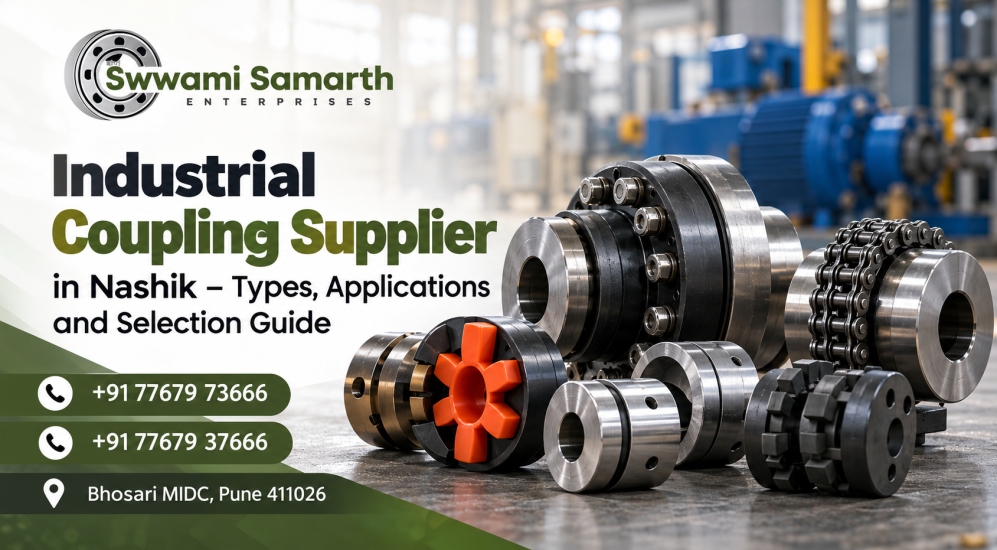
Industrial machinery requires several mechanical components to work together smoothly. In machines where rotational power needs to move from one shaft to another, industrial couplings play an important role. They connect driving and driven shafts and help transfer torque between connected equipment.
Couplings are commonly used in pumps, motors, compressors, conveyors and manufacturing machinery. Different machines require different coupling designs depending on operating speed, torque, shaft alignment and working conditions.
For businesses looking for an Industrial Coupling Supplier in Nashik, understanding coupling types and their applications can make product selection easier. Choosing the correct coupling also helps avoid unnecessary vibration, wear and maintenance problems.
What Is an Industrial Coupling?
An industrial coupling is a mechanical component used to connect two rotating shafts. One shaft may be connected to an electric motor, while the other operates a pump, gearbox or other machine.
The coupling transfers rotational power between these components. Some designs can also accommodate limited shaft misalignment and reduce the transmission of vibration.
The correct coupling depends on the machinery arrangement and the operating requirements of the application.
Different Types of Industrial Couplings
Flexible Couplings
Flexible couplings are designed to accommodate limited misalignment between connected shafts. They are commonly used in pumps, compressors, motors and general industrial machinery.
Jaw Couplings
Jaw couplings generally consist of two hubs and an elastomeric element. They are suitable for selected motor-driven applications where compact construction and vibration damping are required.
Gear Couplings
Gear couplings use gear teeth to transfer torque between shafts. They are commonly considered for applications requiring higher torque transmission.
Rigid Couplings
Rigid couplings connect two shafts without providing flexibility for misalignment. They are suitable for machinery arrangements where accurate shaft alignment can be maintained.
Industrial Applications of Couplings
Pumps and Motors
Industrial pumps use motors to operate and transfer fluids. Couplings connect the motor shaft to the pump shaft and help transmit the required rotational power.
Conveyor Systems
Manufacturing units and warehouses use conveyors for material movement. Couplings are used in suitable conveyor drive arrangements to connect rotating components.
Compressor Machinery
Industrial compressors require reliable power transmission. The appropriate coupling should match the compressor’s torque, operating speed and machine arrangement.
Manufacturing Equipment
Production machinery uses motors, gearboxes and rotating components for different operations. Industrial couplings help connect these components and transfer power.
Nashik MIDC, Ambad MIDC and Satpur MIDC have manufacturing and industrial businesses where suitable power transmission components are required. Similar requirements are also found in Pune, Chakan, Bhosari and Kolhapur.
How to Choose the Right Industrial Coupling
Shaft Diameter
Check the diameter of both connected shafts before selecting a coupling. The coupling bore should match the required shaft dimensions.
Torque Requirements
The coupling must be suitable for the torque transmitted by the machine. Applications involving frequent starting, stopping or sudden load changes may require additional consideration.
Operating Speed
Different couplings have different speed limitations. Always check the manufacturer’s specifications before selecting a coupling for high-speed machinery.
Shaft Alignment
Incorrect shaft alignment can increase vibration and mechanical stress. Check the alignment during installation to support proper coupling performance.
Working Environment
Temperature, dust, moisture, oil and chemicals can affect coupling materials. Select a suitable design according to the actual working environment.
Common Coupling Problems and Maintenance
Incorrect selection, loose mounting, misalignment and excessive loads can contribute to coupling problems.
Regular Inspection
Check for cracks, worn elements, loose fasteners and visible damage. Inspect flexible coupling elements according to the manufacturer’s recommendations.
Monitor Vibration and Noise
Unusual vibration or noise may indicate alignment issues or coupling wear. Investigate these changes before they affect connected machinery.
Follow Maintenance Recommendations
Different coupling designs have different maintenance requirements. Follow the manufacturer’s instructions for inspection, lubrication and replacement.
Other Power Transmission Products for Industrial Machinery
Industrial machinery often requires supporting products along with couplings.
V-Belts and Timing Belts
V-belts are used in conventional power transmission systems, while timing belts are suitable for applications requiring synchronised movement.
Taper Lock Pulleys
Taper lock pulleys provide a practical mounting arrangement for suitable shaft and belt-drive systems.
Industrial Bearings
Deep groove ball bearings, spherical roller bearings, tapered roller bearings and other bearing types support rotating shafts in different machinery applications.
Choosing an Industrial Coupling Supplier in Nashik
Before purchasing an industrial coupling, businesses should check the product specifications and machinery requirements.
When contacting an Industrial Coupling Supplier in Nashik, keep the existing coupling number, shaft diameter, operating speed, torque requirements and machine application ready.
Businesses in Nashik, Pune, Chhatrapati Sambhajinagar, Satara, Sangli and Kolhapur can use these details to identify suitable power transmission products for their machinery.
Shri Swami Samarth Enterprises supplies industrial bearings, bearing accessories, V-belts, timing belts, taper lock pulleys and industrial couplings for different industrial requirements.
Conclusion
Industrial couplings connect rotating shafts and transfer power between different machine components. Flexible, jaw, gear and rigid couplings are used for different applications depending on torque, speed and alignment requirements.
For businesses searching for an Industrial Coupling Supplier in Nashik, checking shaft dimensions, operating conditions and product specifications before ordering is important. The right coupling can support reliable power transmission and help reduce unnecessary maintenance problems.
FAQs
1. What is an industrial coupling used for?
An industrial coupling connects two rotating shafts and transfers torque from a driving machine to a driven machine.
2. Which coupling is commonly used in industrial machinery?
Flexible, jaw, gear and rigid couplings are used in different applications depending on the machine requirements.
3. How do I select the correct industrial coupling?
Check shaft diameter, torque, operating speed, alignment, machine application and working environment.
4. Can a coupling handle shaft misalignment?
Some flexible coupling designs can accommodate limited misalignment. The permitted amount depends on the coupling specifications.
5. What causes coupling failure?
Incorrect selection, excessive torque, misalignment, loose fasteners and improper installation can contribute to coupling failure.
CTA
Looking for industrial couplings and power transmission products in Maharashtra?
Shri Swami Samarth Enterprises supplies industrial couplings, V-belts, timing belts, taper lock pulleys, industrial bearings and bearing accessories.
Share your coupling specifications and machine application to identify a suitable product.