
Timing Belt Supplier in Maharashtra – Types, Applications and Selection Guide
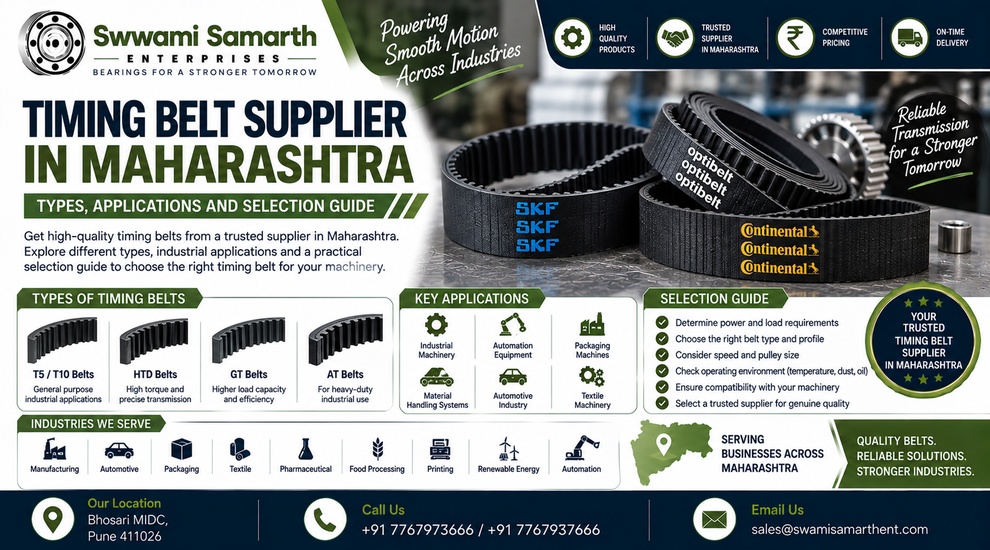
Timing belts are an important part of many industrial power transmission systems. Unlike conventional belts that mainly depend on friction, timing belts use teeth that engage with matching pulley grooves to provide synchronised movement.
This makes them useful in machinery where accurate rotational timing and consistent power transmission are important. They are used across manufacturing equipment, automation systems, packaging machinery, material handling equipment and several other applications.
For businesses searching for a Timing Belt Supplier in Maharashtra, choosing the right belt requires more than simply matching its length. Belt profile, pitch, width, operating speed, load and machine arrangement should all be considered before procurement.
What Is a Timing Belt?
A timing belt is a toothed power transmission belt designed to work with a compatible toothed pulley. The teeth help maintain a positive engagement between the belt and pulley during operation.
Because of this design, timing belts are useful where synchronised movement between rotating components is required.
They are commonly used in machinery where maintaining the relationship between the driving and driven shafts is important.
How Do Timing Belts Work?
A timing belt runs around toothed pulleys. As the driving pulley rotates, its teeth engage with the belt teeth and transfer motion to the driven pulley.
This positive engagement helps reduce the possibility of belt slip under suitable operating conditions.
The complete system depends on proper compatibility between the belt and pulley. Therefore, replacing only the belt without checking the pulley condition or specifications may not always be the right approach.
Types of Timing Belts
Different timing belt profiles and constructions are available for different machinery requirements.
Trapezoidal Tooth Timing Belts
These belts use a trapezoidal tooth profile and are widely used in various mechanical power transmission applications.
The correct pitch and dimensions should be selected according to the compatible pulley system.
Curvilinear Tooth Timing Belts
Curvilinear profiles are designed with a different tooth geometry that can provide suitable load distribution and engagement for particular applications.
They are used in machinery where the belt design needs to accommodate specific transmission requirements.
Industrial Timing Belts
Industrial timing belts are available in different sizes, widths and specifications for machinery and automation applications.
The suitable belt depends on factors such as speed, torque, operating environment and required transmission accuracy.
Common Applications of Timing Belts
Timing belts are used across many industries because of their ability to provide synchronised power transmission.
Packaging Machinery
Packaging machines often require coordinated movement between different shafts and components.
Timing belts can be used in suitable machine arrangements where synchronised movement is required.
Automation Equipment
Automated machinery depends on accurate and repeatable movement. Timing belt systems can be used in appropriate applications for transferring motion between mechanical components.
Conveyor Systems
Some conveyor arrangements use timing belts where controlled movement and positive engagement are required.
The belt specification should match the conveyor’s speed, load and operating conditions.
Textile Machinery
Textile machines may contain several rotating and synchronised components. Timing belts can be used in suitable transmission arrangements where accurate motion transfer is required.
Printing Machinery
Printing equipment often requires coordinated movement between rollers and other rotating components. Timing belt systems can support synchronised transmission in suitable machine designs.
General Industrial Machinery
Manufacturing equipment, processing machines and other industrial systems may use timing belts for controlled power transmission.
Benefits of Timing Belts
Synchronized Power Transmission
The toothed design allows the belt to engage directly with the pulley. This makes timing belts suitable for applications where synchronised movement is important.
Reduced Belt Slip
Under suitable operating conditions, tooth engagement helps minimise the type of slipping associated with friction-drive belts.
Accurate Motion Transfer
Timing belt systems can provide consistent movement between connected shafts when properly selected and installed.
Low Routine Maintenance
Timing belts do not generally require lubrication in the way many mechanical components do. However, regular inspection is still important to identify wear, damage, incorrect tension or other issues.
How to Choose the Right Timing Belt
Choosing a timing belt should be based on the actual requirements of the machinery.
Check Belt Pitch
Pitch refers to the distance between corresponding points on adjacent belt teeth.
The belt pitch must match the pulley profile. An incorrect pitch will not provide the required engagement.
Check Belt Width
The belt width affects the belt’s ability to handle the required transmission load.
The correct width should be selected according to the machine’s power and operating requirements.
Consider Operating Speed
Timing belts used at higher speeds may have different requirements compared with slower applications.
Check the machine’s operating speed before selecting the belt and ensure the chosen specification is appropriate.
Consider Torque and Load
The transmitted power and torque are important selection factors. A belt that is unsuitable for the required load may experience excessive wear or premature failure.
Check Operating Environment
Temperature, dust, moisture, chemicals and other environmental factors can affect belt performance.
The belt material and construction should be suitable for the environment in which the machinery operates.
Timing Belt Maintenance Tips
Although timing belts are designed for reliable power transmission, regular inspection is still necessary.
Maintenance teams should check for:
-
Cracks
-
Tooth wear
-
Fraying
-
Surface damage
-
Incorrect tension
-
Oil or chemical contamination
-
Pulley wear
-
Abnormal noise
If a belt shows significant damage, it should be investigated and replaced according to the manufacturer’s recommendations.
Importance of Correct Belt Tension
Timing belt tension should be maintained according to the system’s specifications.
A belt that is too loose may not maintain proper engagement, while excessive tension can increase stress on the belt and connected components.
Correct tension supports proper belt operation and helps avoid unnecessary wear.
When adjusting tension, the pulley alignment and mounting arrangement should also be checked.
Check the Timing Pulley Before Replacement
A new timing belt may not perform properly if the existing pulley is worn or damaged.
Before installing a replacement belt, inspect the pulley teeth for abnormal wear or damage. Also check whether the pulleys are properly aligned.
If the pulley and belt profiles are not compatible, the transmission system may experience premature wear or operating problems.
Timing Belts vs V-Belts
Timing belts and V-belts are both used for power transmission, but their operating principles are different.
A V-belt primarily transfers power through friction between the belt and pulley, while a timing belt uses toothed engagement.
Timing belts are generally preferred where synchronised motion is important. V-belts can be suitable for many conventional power transmission applications.
The correct choice depends on the machine’s design, transmission requirements and operating conditions.
Why Choose a Timing Belt Supplier in Maharashtra?
For manufacturing and industrial businesses, timely availability of the correct transmission belt can be important for maintenance and production schedules.
A reliable Timing Belt Supplier in Maharashtra can help businesses source belts according to required pitch, width, length and application.
It is useful to share the existing belt marking, dimensions, machine application and pulley information with the supplier. This can make identification and replacement easier.
More Than Timing Belts
Industrial power transmission systems often require multiple supporting products.
V-Belts
V-belts are widely used in conventional power transmission systems across industrial machinery, pumps, fans and other equipment.
Taper Lock Pulleys
Taper lock pulleys provide a practical pulley mounting arrangement for suitable shaft and transmission systems.
Industrial Couplings
Couplings are used to connect shafts and transfer torque between rotating machine components. Selection depends on shaft arrangement, torque and operating conditions.
Bearings and Bearing Accessories
Bearings, bearing housings, sleeves, lock nuts and lock washers may also be required in machinery where timing belt systems are installed.
What to Check Before Ordering a Timing Belt
Before contacting a Timing Belt Dealer in Maharashtra, keep the following information ready:
-
Existing belt number or marking
-
Belt length
-
Belt width
-
Tooth profile
-
Pitch
-
Number of teeth
-
Pulley specifications
-
Machine application
-
Operating speed
-
Power or load requirements
Providing accurate details helps reduce the chances of ordering an incompatible belt.
Conclusion
Timing belts provide a practical solution for power transmission applications where synchronised movement and accurate motion transfer are important. Their toothed design allows them to work with compatible pulleys and makes them suitable for many industrial machines.
However, selecting the right timing belt requires attention to pitch, width, length, tooth profile, speed, load and operating environment.
For businesses looking for a Timing Belt Supplier in Maharashtra, working with a reliable supplier and sharing complete machine and belt specifications can make the procurement process easier and help identify a suitable transmission solution.
FAQs
1. What is a timing belt used for?
A timing belt is used to transfer power and synchronise rotational movement between shafts through toothed engagement with compatible pulleys.
2. What is the difference between a timing belt and a V-belt?
A timing belt uses teeth to engage with a toothed pulley, while a V-belt generally transfers power through friction between the belt and pulley.
3. How do I choose the right timing belt?
Check the belt pitch, width, length, tooth profile, number of teeth, operating speed, load and machine application.
4. Do timing belts require lubrication?
Timing belts generally do not require lubrication like bearings or chains. However, they should be protected from unsuitable oil, chemicals and environmental contamination according to the belt manufacturer’s recommendations.
5. What causes timing belt failure?
Incorrect tension, pulley misalignment, excessive load, contamination, worn pulleys, improper installation and unsuitable belt selection can contribute to premature belt problems.
6. How often should a timing belt be replaced?
Replacement intervals depend on the belt type, machine application, operating conditions and manufacturer’s recommendations. Regular inspection can help identify when replacement may be required.
Looking for a reliable Timing Belt Supplier in Maharashtra?
Shri Swami Samarth Enterprises supplies timing belts along with V-belts, taper lock pulleys, industrial couplings, bearings and other power transmission products for industrial machinery requirements.
Share your existing belt specifications or machine requirements to identify a suitable timing belt solution.