
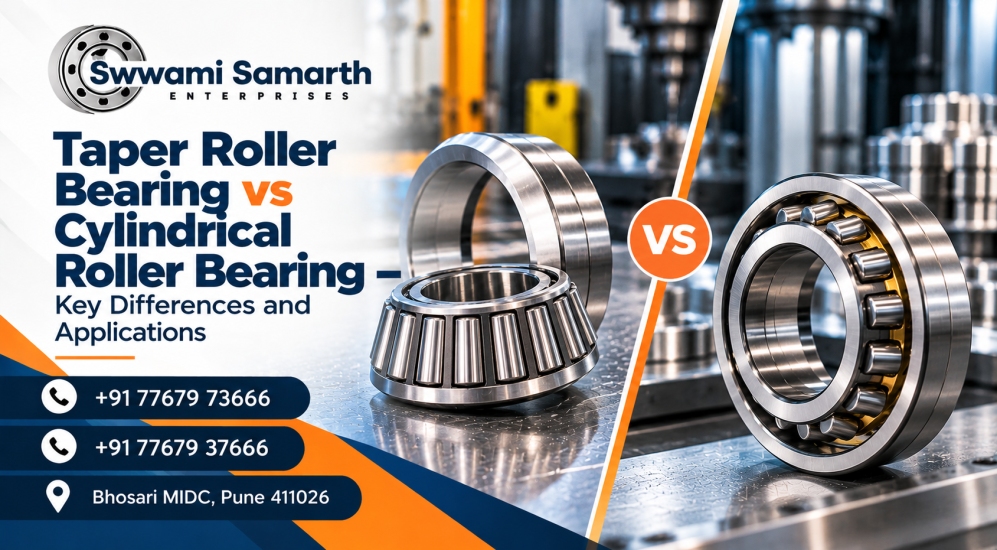
Roller Bearing Comparison: Taper Roller vs Cylindrical Roller
Roller Bearing Comparison is important when selecting bearings for industrial machinery that operates under demanding load conditions. Taper roller bearings and cylindrical roller bearings are designed to support different types of loads and operating requirements. Understanding their construction, load capacity and applications helps engineers identify a suitable bearing for their equipment.
Although both bearing types use rolling elements, their roller geometry and load-handling characteristics are different. This guide explains the key differences, common applications and factors to consider before selecting either bearing.
What Are Roller Bearings?
Roller bearings are rolling element bearings that use rollers instead of balls to support loads between rotating or moving components. The rollers create contact with the raceways and help distribute the applied load.
Different roller bearing designs are available for different operating conditions. Their suitability depends on load direction, speed, alignment, dimensions and machine requirements.
What Is a Taper Roller Bearing?
A taper roller bearing uses conical rollers positioned between specially designed inner and outer raceways. The geometry allows the bearing to support combined radial and axial loads.
Taper roller bearings are often used in applications where both radial and axial forces are present. They are available in different sizes and configurations, including single-row and multi-row arrangements.
What Is a Cylindrical Roller Bearing?
A cylindrical roller bearing uses cylindrical-shaped rollers that run between the inner and outer raceways. Its design provides a large contact area, making it suitable for applications requiring high radial load capacity.
Different cylindrical roller bearing designs are available, including configurations that can accommodate limited axial displacement or support axial loads in specified directions.
Taper roller bearings are commonly selected for combined radial and axial loads, while cylindrical roller bearings are generally used where high radial load capacity is a major requirement.
Roller Bearing Comparison: Design and Construction
Uses conical rollers and matching tapered raceways to support combined loads.
- Conical roller geometry
- Combined radial and axial load capability
- Often requires suitable adjustment or preload
- Available in different mounting arrangements
- Common in automotive and industrial equipment
Uses cylindrical rollers between the inner and outer raceways.
- Cylindrical roller geometry
- High radial load capability
- Different designs for axial displacement
- Available in multiple bearing configurations
- Common in motors and heavy machinery
Major Differences in Roller Bearing Performance
Radial Load Capacity
Cylindrical roller bearings are widely used for applications requiring high radial load capacity. Taper roller bearings can also support radial loads, along with axial loads according to their design.
Axial Load Capacity
Taper roller bearings are designed to support combined radial and axial loads. Cylindrical roller bearing axial load capability depends on the particular design and flange arrangement.
Mounting Arrangement
Taper roller bearings are often arranged in pairs to manage axial loads in both directions. Cylindrical roller bearings are selected according to the required radial and axial locating arrangement.
Operating Conditions
Both bearing types are available for different speeds and loads. Permissible operating speed depends on bearing design, lubrication, dimensions and working conditions.
Maintenance Requirements
Both designs require suitable lubrication, correct mounting and regular inspection. The maintenance procedure should follow the manufacturer's recommendations.
Taper Roller Bearing vs Cylindrical Roller Bearing: Comparison Table
The following table provides a general comparison of both bearing types. Actual performance depends on the bearing series and manufacturer specifications.
| Parameter | Taper Roller Bearing | Cylindrical Roller Bearing |
|---|---|---|
| Roller Shape | Conical | Cylindrical |
| Main Load Capability | Combined radial and axial | High radial load |
| Axial Load | Supported according to arrangement | Depends on design and flanges |
| Mounting | Often used in pairs | Depends on bearing configuration |
| Typical Applications | Gearboxes, wheel hubs and machinery | Motors, gearboxes and heavy equipment |
| Selection Factors | Combined load and adjustment | Radial load and axial arrangement |
Industrial Applications of Taper Roller Bearings
Automotive Wheel Assemblies
Taper roller bearings are commonly used in suitable wheel hub and axle arrangements where radial and axial forces act together.
Industrial Gearboxes
Certain gearbox arrangements use taper roller bearings to support shaft loads and manage combined loading conditions.
Heavy Industrial Machinery
Machinery with combined radial and axial loads may use taper roller bearings when the bearing arrangement meets the application requirements.
Industrial Applications of Cylindrical Roller Bearings
Electric Motors and Generators
Cylindrical roller bearings are used in suitable motor and generator arrangements where high radial load support is required.
Industrial Gearboxes
Gearbox designs may use cylindrical roller bearings to support radial loads on rotating shafts.
Heavy Manufacturing Equipment
Industrial equipment operating under substantial radial loads may use cylindrical roller bearings according to its design specifications.
How to Select the Right Roller Bearing
A proper Roller Bearing Comparison should consider the actual working conditions rather than only the bearing dimensions. Check these factors before finalising a product.
Identify the Load Direction
Determine whether the machine produces radial loads, axial loads or combined loads.
Calculate the Applied Load
Consider normal operating load, shock load and any additional forces generated during acceleration or operation.
Check Bearing Dimensions
Verify bore diameter, outside diameter and width against the available shaft and housing space.
Review Speed and Temperature
Confirm the operating speed, temperature and lubrication conditions against the manufacturer's specifications.
Confirm the Mounting Arrangement
Check bearing orientation, axial location, clearance and adjustment requirements.
Which Roller Bearing Is Suitable?
A taper roller bearing may be suitable when the application involves combined radial and axial loads.
A cylindrical roller bearing may be suitable when high radial load capacity is a major requirement.
The final selection should always be based on the machine design, bearing arrangement and manufacturer's technical data.
Common Roller Bearing Selection Mistakes
- Choosing a bearing only by its physical dimensions.
- Ignoring the direction and magnitude of axial loads.
- Overlooking the correct mounting arrangement.
- Not checking permissible operating speed.
- Ignoring lubrication and operating temperature.
- Replacing a bearing without checking its complete designation.
Frequently Asked Questions About Roller Bearings
1. What is the main difference between taper and cylindrical roller bearings?
Taper roller bearings use conical rollers and are designed for combined radial and axial loads. Cylindrical roller bearings use cylindrical rollers and are commonly selected for high radial load applications.
2. Which roller bearing is suitable for high radial loads?
Cylindrical roller bearings are commonly used where high radial load capacity is required, subject to the bearing design and operating conditions.
3. Can taper roller bearings support axial loads?
Yes. Taper roller bearings are designed to support axial loads along with radial loads. Their arrangement determines the supported axial directions.
4. Are cylindrical roller bearings suitable for gearboxes?
Yes. Certain gearbox designs use cylindrical roller bearings to support radial loads on rotating shafts.
5. Do taper roller bearings require adjustment?
Some taper roller bearing arrangements require clearance or preload adjustment. Follow the manufacturer's mounting instructions for the particular design.
6. Can both bearing types be used in industrial machinery?
Yes. Both are used in industrial machinery. The correct choice depends on load direction, speed, dimensions and mounting requirements.
External Technical Resources
Refer to manufacturer resources for roller bearing product details, technical catalogues and application guidance.
About Shri Swami Samarth Enterprises
Shri Swami Samarth Enterprises deals in industrial bearings and machinery-related products for different manufacturing and industrial requirements. Understanding bearing specifications and application conditions helps customers identify suitable products for their machinery.
Learn more about the company through the About Us page .
Explore More Industrial Articles
Read more useful information about industrial bearings, machine components and motion-related products in our Articles section .
Looking for Industrial Roller Bearings?
Share your bearing number, dimensions or machinery application requirements with Shri Swami Samarth Enterprises to discuss suitable industrial bearing options.
Contact Us