
Bearing Failure Causes in Industrial Machinery – Common Problems and How to Prevent Them
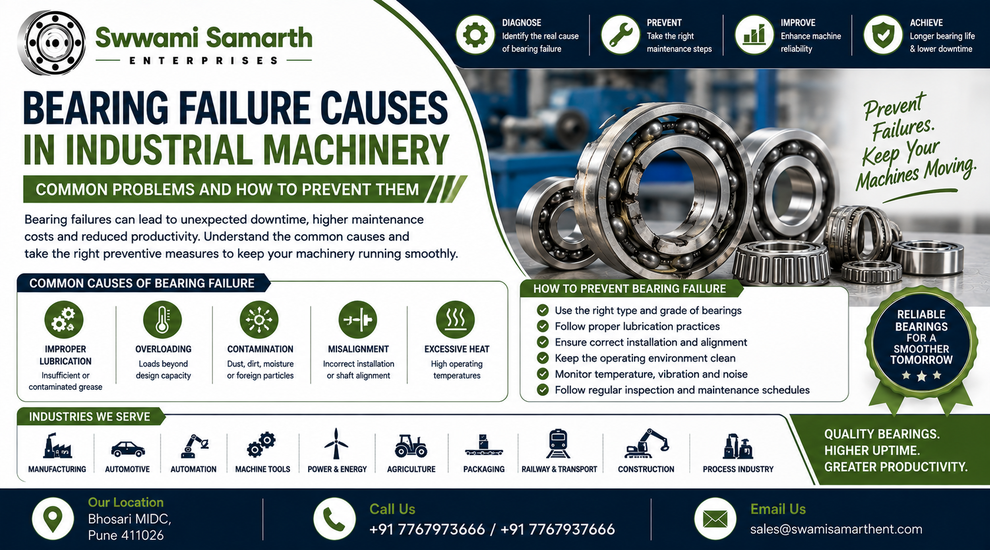
Bearings are small components, but their role in industrial machinery is extremely important. They support rotating shafts, reduce friction and help machines operate smoothly. When a bearing starts developing a problem, the effect can quickly spread to other machine components.
Bearing failure can result in unexpected machine stoppage, production delays, maintenance expenses and frequent replacement requirements. In many cases, the bearing itself may not be the only problem. Incorrect installation, poor lubrication, excessive load, contamination or unsuitable bearing selection can also lead to premature failure.
Understanding the common bearing failure causes in industrial machinery helps maintenance teams identify problems early and take preventive action before they become costly breakdowns.
Why Do Industrial Bearings Fail?
An industrial bearing is designed to work under specific load, speed, temperature and operating conditions. When any of these conditions go beyond the suitable range, the bearing can experience excessive stress.
Some failures happen gradually, while others can occur suddenly. Regular inspection and correct maintenance can help identify early warning signs such as unusual noise, vibration, overheating or increased friction.
Let us look at some of the most common reasons behind industrial bearing failure.
Common Bearing Failure Causes in Industrial Machinery
1. Improper Lubrication
Lubrication is one of the most important factors affecting bearing performance. Bearings need the correct lubricant and appropriate quantity to reduce friction between moving surfaces.
Too little lubricant can increase friction and temperature, while excessive lubrication can also create problems, particularly in high-speed applications.
Before applying grease or oil, check the bearing manufacturer’s recommendations regarding lubricant type, quantity and relubrication interval.
2. Contamination
Dust, dirt, water, metal particles and other contaminants can enter the bearing assembly and damage the rolling elements or raceways.
This is particularly important in industries where machinery operates in dusty, wet or chemically exposed environments.
Proper sealing, clean handling practices and regular inspection can help reduce contamination-related bearing damage.
3. Overloading
Every bearing has a specific load capacity. If the bearing is continuously subjected to loads beyond its intended operating range, excessive stress can develop on the rolling elements and raceways.
Heavy loads can lead to premature wear, surface damage and increased operating temperature.
Selecting a bearing according to the actual radial and axial load requirements is therefore important for reliable machine operation.
4. Incorrect Installation
Even a high-quality bearing can fail early if it is installed incorrectly.
Using excessive force, applying force to the wrong bearing ring, misalignment or using unsuitable installation tools can damage the bearing before the machine even starts operating.
Installation should be carried out using appropriate tools and procedures to avoid unnecessary impact or mounting damage.
5. Misalignment
Shaft and housing alignment plays an important role in bearing life. When the bearing is not properly aligned, the load may not be distributed evenly across the rolling elements.
This can result in uneven wear, vibration and increased operating temperature.
Checking shaft alignment, housing condition and mounting accuracy can help prevent unnecessary bearing stress.
Other Factors That Can Cause Bearing Damage
Excessive Operating Speed
Bearings designed for a particular speed range may not perform properly when operated beyond their suitable limits.
High rotational speed can increase friction, heat generation and lubricant stress. For high-speed machinery, bearing selection should consider speed as well as load requirements.
High Temperature
Excessive operating temperature can affect lubricant performance and bearing materials. Continuous overheating may indicate lubrication problems, excessive load, poor alignment or another machine-related issue.
Temperature monitoring can help maintenance teams identify abnormal operating conditions at an early stage.
Electrical Damage
In certain electric motor and industrial equipment applications, electrical current passing through a bearing can cause surface damage. Proper bearing selection and suitable electrical protection measures may be required depending on the application.
Poor Storage and Handling
Bearing performance can also be affected before installation if bearings are stored or handled incorrectly.
Moisture, dust, improper packaging and rough handling can affect bearing condition. Bearings should be kept in a clean, dry environment and handled carefully until they are ready for installation.
Warning Signs of Bearing Failure
Identifying early symptoms can help prevent an unexpected breakdown.
Common warning signs include:
Unusual bearing noise
Increased vibration
Excessive operating temperature
Abnormal friction
Grease leakage or lubricant contamination
Shaft movement or looseness
Visible wear or surface damage
Reduced machine performance
Repeated bearing replacement
A bearing showing these symptoms should be inspected instead of simply replacing it without finding the actual cause.
How to Prevent Industrial Bearing Failure
Preventive maintenance is generally more effective than waiting for a bearing to fail completely.
Some practical measures include:
Select the correct bearing for the application.
Follow recommended lubrication practices.
Keep bearings protected from dust and moisture.
Use proper installation tools.
Check shaft and housing alignment.
Monitor temperature and vibration.
Avoid operating machinery beyond its designed load.
Store replacement bearings properly.
Inspect failed bearings to understand the actual failure reason.
These steps can help improve bearing reliability and reduce unnecessary maintenance interruptions.
Choosing the Right Bearing for Industrial Machinery
Not every bearing is suitable for every machine. Deep groove ball bearings, spherical roller bearings, cylindrical roller bearings, tapered roller bearings, needle roller bearings and angular contact ball bearings are designed for different operating requirements.
Before selecting a bearing, consider:
Radial load
Axial load
Operating speed
Temperature
Available space
Shaft and housing dimensions
Lubrication conditions
Environmental conditions
Expected operating life
Choosing the right bearing at the beginning can reduce the chances of premature industrial bearing failure.
Why Reliable Bearing Supply Matters
The quality and suitability of the bearing can directly affect machine performance. For industrial applications, businesses should avoid selecting bearings only on the basis of the lowest initial price.
A reliable industrial bearing supplier can help businesses source the required bearing type, dimensions and related components according to their application.
Along with bearings, supporting products such as bearing housings, sleeves, lock nuts, lock washers, industrial grease and other maintenance products can also be important for a complete bearing solution.
More Than Bearings for Industrial Applications
Industrial machinery often requires several mechanical components to work together.
Bearing Accessories
Bearing housings, pillow block housings, adapter sleeves, withdrawal sleeves, lock nuts, lock washers and locating rings can support proper bearing installation and operation.
Power Transmission Products
V-belts, timing belts, taper lock pulleys and industrial couplings are commonly used in power transmission systems. Selecting compatible transmission components can help maintain efficient machine operation.
Industrial Oils and Lubricants
Hydraulic oil, gear oil, compressor oil, industrial lubricants and grease are also important for machinery maintenance. Correct lubrication practices can support smoother operation and help reduce unnecessary wear.
What Industries Need to Check Before Replacing a Failed Bearing
Replacing a failed bearing without investigating the reason can result in the same problem happening again.
Before installing a new bearing, maintenance teams should check:
What caused the previous bearing to fail?
Was the bearing correctly selected?
Was the correct lubricant used?
Was the bearing properly installed?
Was there any shaft or housing misalignment?
Was the machine operating under excessive load?
Was contamination present?
Were abnormal temperature or vibration levels noticed?
Finding the root cause is just as important as replacing the damaged bearing.
Conclusion
Bearing failure can affect machine reliability, production schedules and maintenance costs. The major bearing failure causes in industrial machinery include improper lubrication, contamination, overloading, incorrect installation, misalignment, excessive speed and unsuitable operating conditions.
Regular inspection, proper lubrication, correct installation and application-based bearing selection can significantly reduce the risk of premature failure.
For industrial machinery, the objective should not simply be to replace a failed bearing. The better approach is to understand why it failed and take preventive steps so the same issue does not happen again.
FAQs
1. What are the most common causes of bearing failure?
Improper lubrication, contamination, overloading, incorrect installation, misalignment, excessive speed and high operating temperature are common causes.
2. Can poor lubrication cause bearing failure?
Yes. Insufficient, excessive or unsuitable lubrication can increase friction and temperature and may contribute to premature bearing damage.
3. How can bearing failure be prevented?
Correct bearing selection, proper installation, suitable lubrication, contamination control, alignment checks and preventive maintenance can help reduce bearing failure.
4. Why does a bearing overheat?
Bearing overheating can be related to excessive load, poor lubrication, high speed, misalignment or other operating conditions.
5. Should a failed bearing simply be replaced?
Not always. The cause of failure should be investigated before replacement. Otherwise, the new bearing may experience the same problem.
6. How do I choose the right industrial bearing?
Consider the machine’s load, speed, temperature, shaft dimensions, operating environment, available space and lubrication requirements before selecting a bearing.
Looking for reliable bearings and industrial mechanical components for your machinery?
Shri Swami Samarth Enterprises supplies a wide range of industrial bearings, bearing accessories, power transmission products, linear motion solutions and industrial lubricants for different applications.
Choose the right bearing based on your machine requirements and operating conditions to support reliable performance and reduce unnecessary maintenance.