
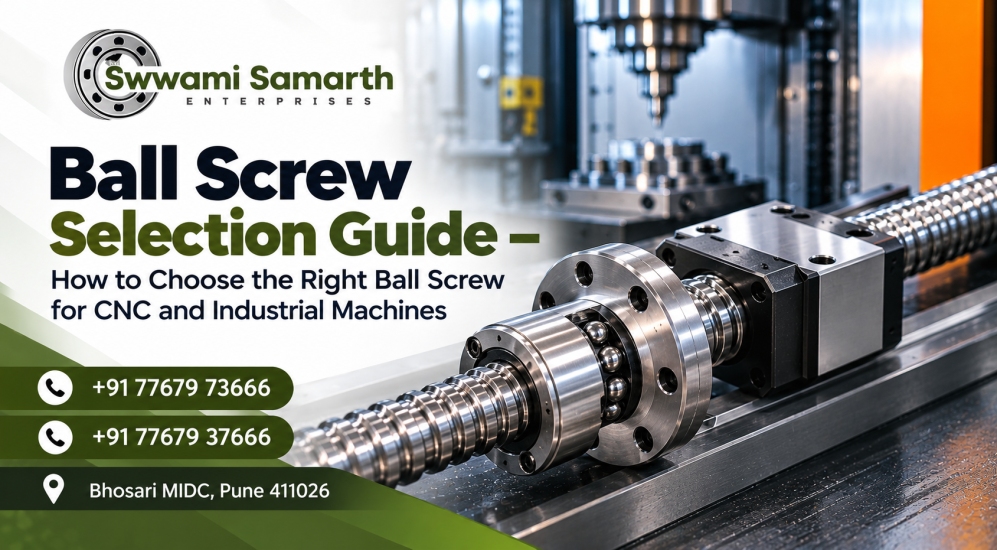
Understanding Ball Screw Selection for Industrial Applications
Proper Ball Screw Selection is essential for achieving accurate, smooth and reliable linear motion in CNC machines and industrial equipment. A ball screw converts rotary motion into linear movement using a screw shaft and a ball nut containing recirculating balls. This mechanism helps reduce friction and supports precise positioning in demanding applications.
Selecting the wrong ball screw can affect machine accuracy, operating speed, load capacity and overall equipment performance. Therefore, engineers and machine manufacturers should evaluate application requirements before choosing a suitable ball screw.
What Is a Ball Screw and How Does It Work?
A ball screw is a mechanical component used to convert rotational movement into controlled linear movement. It consists mainly of a threaded screw shaft, a ball nut and a set of precision steel balls that circulate between the nut and screw grooves.
When the screw or nut rotates, the balls roll along the specially designed grooves. This rolling contact reduces friction compared with conventional sliding screw mechanisms. As a result, ball screws are widely used in CNC machining centres, automation systems, precision equipment and industrial machinery.
Why Ball Screws Matter
Ball screws help machines achieve controlled movement, repeatable positioning and efficient power transmission. Their performance makes them an important component in applications where precision and consistent movement are required.
6 Important Factors for Ball Screw Selection
Before selecting a ball screw, consider the machine's operating conditions, movement requirements and expected service life. The following factors help simplify the selection process.
Load Capacity
Determine the load that the ball screw must move during operation. Consider both axial load and the forces generated during acceleration and deceleration. The selected ball screw should have sufficient capacity for the actual working conditions.
Lead and Movement Speed
Ball screw lead refers to the linear distance travelled by the nut during one complete revolution. A higher lead can provide greater linear movement per revolution, while a lower lead can support finer movement resolution.
Accuracy Requirements
Different applications require different positioning accuracy. CNC machines and precision equipment may need higher accuracy grades. Consider positioning accuracy, repeatability and the machine's overall tolerance requirements.
Screw Diameter and Length
Screw diameter and unsupported length influence stiffness and operating stability. The dimensions should be selected according to load, speed, installation space and the machine's structural requirements.
Operating Speed
Check the required rotational speed and linear travel speed. The selected ball screw must operate within its permissible speed limits. High-speed applications also require attention to vibration and critical speed.
Mounting and Installation
Consider the mounting arrangement, support bearings, available space and alignment requirements. Correct installation helps reduce unnecessary stress and supports smooth operation.
Understanding Ball Screw Lead and Accuracy
What Is Ball Screw Lead?
Lead is the linear distance travelled by the ball nut when the screw completes one full revolution. It directly affects the relationship between motor rotation and linear movement.
For example, a ball screw with a 10 mm lead moves the nut by 10 mm for every complete revolution, assuming the standard configuration. The appropriate lead depends on the required travel speed, motor characteristics and positioning needs.
Why Is Accuracy Important?
Accuracy determines how closely the actual movement matches the commanded movement. In CNC machining, positioning errors can affect dimensional accuracy and finished product quality. Therefore, selecting an appropriate accuracy grade is important for precision applications.
Ball Screw Specifications to Compare
Comparing technical specifications makes it easier to shortlist suitable ball screws. Always refer to the manufacturer's technical catalogue for exact permissible values and product configurations.
| Specification | What to Check | Why It Matters |
|---|---|---|
| Screw Diameter | Available shaft diameter | Strength and stiffness |
| Lead | Linear travel per revolution | Speed and movement resolution |
| Accuracy Grade | Required positioning tolerance | Movement precision |
| Load Capacity | Axial and dynamic loads | Operating reliability |
| Overall Length | Required travel and installation | Machine compatibility |
| Support Arrangement | Fixed and supported ends | Stability during operation |
Common Applications of Ball Screws
Ball screws are used in industries where controlled linear motion and repeatable positioning are important. Their design makes them suitable for a wide range of machinery and automation systems.
CNC Machines
CNC machines use ball screws to move machine axes accurately. They support controlled movement during cutting, drilling, milling and other machining operations.
Industrial Automation
Automated production systems use ball screws in positioning units, transfer mechanisms and precision movement assemblies.
Robotics and Special Purpose Machines
Ball screws can be used in robotic positioning systems and special purpose machines that require controlled linear movement.
Precision Equipment
Testing machines, inspection equipment and other precision systems may use ball screws where repeatable movement is an important requirement.
Common Mistakes to Avoid During Ball Screw Selection
- Selecting a ball screw without calculating the actual load.
- Ignoring lead requirements and the required linear speed.
- Choosing an accuracy grade without considering application needs.
- Overlooking critical speed and unsupported screw length.
- Ignoring mounting arrangements and alignment requirements.
- Not checking lubrication, sealing and maintenance requirements.
- Choosing only on initial price instead of overall suitability.
Ball Screw Maintenance Tips for Better Performance
Correct maintenance helps support reliable operation and can reduce premature wear. Follow the manufacturer's maintenance instructions and consider the following practices:
- Use the recommended lubricant and lubrication interval.
- Keep the screw shaft and surrounding area free from contamination.
- Inspect seals and protective covers regularly.
- Check for unusual noise, vibration or irregular movement.
- Verify alignment and mounting conditions during maintenance.
- Follow the manufacturer's installation and operating guidelines.
Choosing a Suitable Ball Screw for Your Application
The right ball screw depends on the machine design, load conditions, travel speed, accuracy requirements and installation arrangement. A detailed evaluation of these factors helps identify a suitable configuration for the intended application.
Manufacturers and maintenance teams should compare technical specifications rather than selecting a component based only on dimensions or price. Consulting product catalogues and technical support can help avoid compatibility issues.
Explore Manufacturer Information
Frequently Asked Questions About Ball Screws
1. What is the main function of a ball screw?
A ball screw converts rotary motion into linear movement. It is commonly used in CNC machines and industrial equipment requiring controlled positioning.
2. How do I select the right ball screw?
Consider load capacity, lead, accuracy, screw diameter, length, operating speed and mounting arrangement before finalising a ball screw.
3. What does ball screw lead mean?
Ball screw lead is the linear distance travelled by the ball nut during one complete revolution of the screw.
4. Are ball screws suitable for CNC machines?
Yes. Ball screws are widely used in CNC machines because they support controlled linear movement and precise positioning when correctly selected and installed.
5. Why is ball screw maintenance important?
Regular inspection, correct lubrication and protection from contamination help maintain smooth operation and support longer service life.
6. Can one ball screw specification suit every machine?
No. Different machines have different load, speed, accuracy and installation requirements. Selection should be based on the actual application.
About Swami Samarth Enterprises
Shri Swami Samarth Enterprises provides industrial products and motion-related solutions for various machinery and manufacturing requirements. Understanding application requirements and selecting suitable components are important steps towards dependable machine performance.
Learn more about the company through the About Us page .
Explore More Industrial Articles
Read more technical information, product guides and industrial topics in our Articles section .
Looking for the Right Ball Screw?
Choosing the correct ball screw starts with understanding your machine's requirements. Contact Shri Swami Samarth Enterprises to discuss your industrial product requirements.
Contact Us