
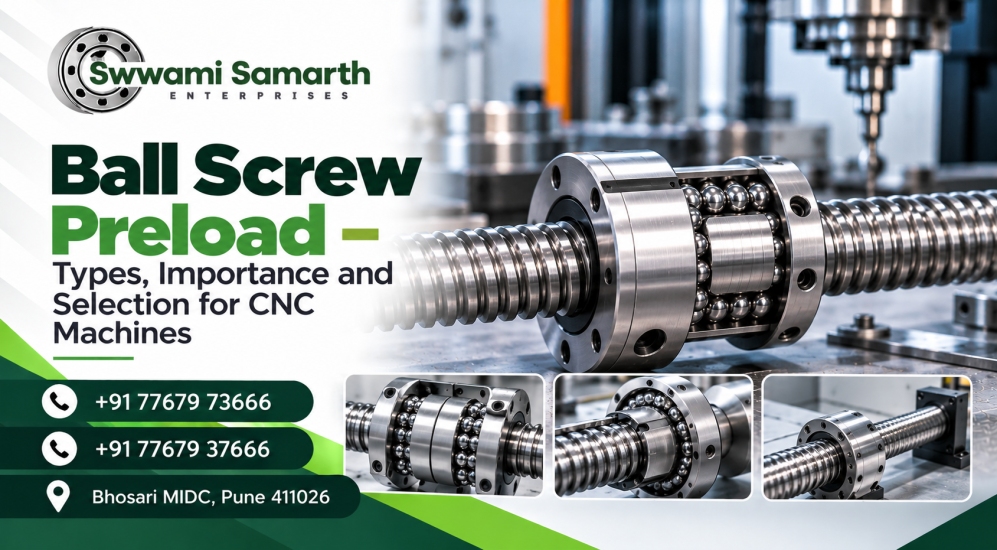
Ball Screw Preload: Understanding Its Types and Importance
Ball Screw Preload is an important design feature used in many precision linear motion applications. It involves applying a controlled internal load to the ball screw assembly to reduce internal clearance and improve positioning behaviour. Preload can help reduce backlash and improve system rigidity when correctly selected for the application.
CNC machines, precision positioning systems and automated equipment may require a preloaded ball screw arrangement. Understanding preload methods, benefits and limitations helps engineers choose a suitable ball screw for their machine requirements.
What Is Ball Screw Preload?
Ball Screw Preload refers to the controlled internal force applied within a ball screw and nut assembly to eliminate or reduce internal axial clearance. It helps maintain contact between the rolling elements and the raceway surfaces under specified operating conditions.
In a conventional ball screw arrangement, a small amount of internal clearance may allow relative movement when the direction of load changes. A preloaded arrangement is designed to reduce this movement and improve the mechanical response of the system.
Preload is not the same as external working load. It is an internal design condition created within the ball screw assembly. The selected preload must match the required rigidity, speed, load and operating conditions.
Why Is Ball Screw Preload Important?
1. Helps Reduce Backlash
Backlash is unwanted movement that can occur when the direction of motion changes. Ball Screw Preload helps reduce internal axial clearance, supporting more controlled movement during direction changes.
2. Improves Axial Rigidity
Rigidity describes how much a mechanical system resists deformation under an applied load. A suitable preload can improve the axial stiffness of a ball screw assembly.
3. Supports Positioning Accuracy
In precision machinery, unwanted movement can influence positioning performance. Reducing internal clearance can help the system respond more consistently to commanded movement.
4. Improves Motion Control
A properly designed preloaded assembly can provide more consistent movement under changing load conditions. This is useful in machine tools and precision automation systems.
5. Supports Repeatable Machine Movement
Reduced internal movement can help improve repeatability in suitable applications. Actual performance also depends on the complete machine structure, installation and control system.
Main Types of Ball Screw Preload
Ball screw manufacturers use different preload arrangements depending on the product design and application requirements. Common approaches include single-nut preload and double-nut preload.
Single-Nut Preload
A single-nut preloaded design creates internal preload within one nut assembly through its specialised ball circuit or internal design. It can provide a compact arrangement where the application requires reduced backlash without a separate second nut.
Double-Nut Preload
A double-nut arrangement uses two nut components with a designed preload between them. The arrangement may use spacers or other adjustment methods depending on the manufacturer's design. It is used in applications requiring specific rigidity and positioning characteristics.
Single-Nut vs Double-Nut Ball Screw Preload
Both arrangements can reduce internal clearance, but their construction and installation requirements differ. The suitable design depends on the machine's space, load, rigidity and performance requirements.
| Parameter | Single-Nut Preload | Double-Nut Preload |
|---|---|---|
| Construction | One specially designed nut assembly | Two nut components |
| Space Requirement | Generally more compact | Requires space for the two-nut arrangement |
| Preload Design | Created within the nut design | Created between the nut components |
| Adjustment | Depends on the product design | Depends on spacer or adjustment arrangement |
| Selection | Based on compactness and performance needs | Based on rigidity and design requirements |
Understanding Ball Screw Backlash and Preload
Backlash refers to the relative movement between mating components when the direction of motion or applied load changes. In a ball screw assembly, internal clearance can contribute to this movement.
Ball Screw Preload is used to reduce this internal clearance by maintaining a controlled internal contact condition. This can improve positioning behaviour, especially in applications where direction changes and repeatability are important.
However, preload does not eliminate every source of machine error. Coupling flexibility, bearing movement, mounting alignment, thermal expansion and structural deformation can also affect positioning accuracy.
How Preload Affects Ball Screw Rigidity
Axial rigidity is an important characteristic in machine tool and precision motion systems. It describes the resistance of the ball screw assembly to axial deformation under load.
Applying a suitable preload can increase the contact stiffness of the assembly. This helps reduce unwanted displacement under certain loading conditions.
The overall rigidity also depends on screw diameter, lead, unsupported length, bearing support arrangement, nut design and mounting structure. Preload should therefore be considered as one part of the complete mechanical design.
Factors to Consider When Selecting Ball Screw Preload
Required Positioning Accuracy
Determine the positioning and repeatability requirements of the machine before selecting a preloaded ball screw.
Applied Axial Load
Consider the expected working load and direction of loading during normal operation.
Operating Speed
Higher operating speeds can influence heat generation and lubrication requirements. Check the manufacturer's permissible speed and preload recommendations.
Operating Temperature
Temperature changes can influence component expansion and the operating condition of the assembly.
Machine Rigidity Requirements
Evaluate the complete mechanical structure, including screw support bearings and mounting surfaces, rather than considering the nut alone.
Manufacturer Specifications
Select the preload level and arrangement according to the ball screw manufacturer's technical documentation.
Industrial Applications of Preloaded Ball Screws
1. CNC Machine Tools
CNC machines use ball screw assemblies to convert rotary movement into controlled linear movement. Preloaded designs may be selected where reduced backlash and positioning performance are important.
2. Precision Grinding Machines
Precision grinding equipment may require controlled axis movement. A suitable preloaded ball screw can support the required mechanical rigidity.
3. Automation Equipment
Automated positioning systems may use preloaded ball screws where repeatable linear movement is required for production operations.
4. Measuring and Inspection Systems
Certain precision measurement systems use preloaded linear motion assemblies to support controlled positioning and movement.
5. Industrial Positioning Systems
Specialised machinery may use preloaded ball screws when the application requires controlled axial movement and reduced internal clearance.
Can Excessive Preload Create Problems?
Yes. Although preload can improve rigidity and reduce internal clearance, excessive preload may increase friction and heat generation. It can also increase the load acting on the rolling elements and other components.
The correct preload is therefore a balance between required rigidity and operating performance. Selecting a higher preload without considering speed, load and lubrication can negatively affect the system.
Do not assume that maximum preload always provides the best performance. Follow the manufacturer's recommendations for the selected ball screw model and application.
Common Ball Screw Preload Selection Mistakes
Higher preload may increase friction and operating temperature.
Speed affects thermal behaviour and lubrication requirements.
The complete screw support arrangement influences system rigidity.
Misalignment can create unwanted loads and affect movement.
Preload arrangements and specifications differ between product series.
Load, speed, temperature and machine stiffness also matter.
Frequently Asked Questions About Ball Screw Preload
1. What is Ball Screw Preload?
Ball Screw Preload is a controlled internal force applied within a ball screw assembly to reduce internal axial clearance and improve rigidity.
2. Why is preload used in CNC machines?
Preload can help reduce backlash and improve positioning behaviour in CNC machine axes where controlled linear movement is important.
3. What is the difference between single-nut and double-nut preload?
Single-nut preload is created within one specially designed nut assembly, while double-nut preload is created between two nut components.
4. Does preload eliminate all backlash?
It can reduce internal axial clearance in the ball screw assembly, but other mechanical components may still contribute to system backlash or positioning errors.
5. Can excessive preload damage a ball screw?
Excessive preload can increase friction, temperature and internal loading. The preload must be selected according to manufacturer specifications and application requirements.
6. Which applications require preloaded ball screws?
CNC machine tools, precision positioning systems, grinding machines and certain automation applications may require preloaded ball screw arrangements.
Official Technical Resources
Refer to the manufacturer's product information and technical documentation for ball screw construction, preload arrangements and selection recommendations.
About Shri Swami Samarth Enterprises
Shri Swami Samarth Enterprises deals in industrial bearings and motion-related products for different manufacturing and machinery requirements. Understanding product specifications and application conditions helps customers identify suitable motion components for their equipment.
Learn more about the company through the About Us page .
Explore More Industrial Articles
Explore more informative content about ball screws, industrial bearings and linear motion products in our Articles section .
Looking for Ball Screw Solutions?
Discuss your CNC machine and industrial motion requirements with Shri Swami Samarth Enterprises to explore suitable ball screw options.
Contact Us